Why Resume Accomplishments Matter More Than Resume Templates
A question I hear a lot from job seekers is, “Which resume template or format should I use?”
Less often, I am asked, “How do I identify the accomplishments that will make an employer want to interview me?”
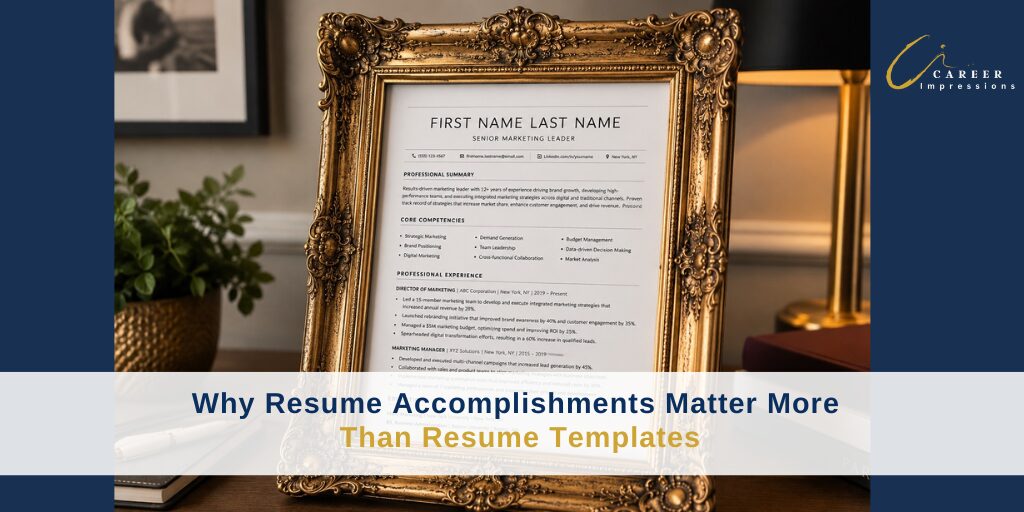
This tells me that too many professionals spend more time choosing fonts, layouts, colours, and columns than they do reflecting on the value they’ve created throughout their careers. It’s a bit like spending more time choosing a picture frame than creating the artwork that goes inside it.
A professional-looking resume certainly has its place. Presentation matters, but presentation alone has never landed someone an interview.
Content does.
Why Resume Content Matters More Than Design
When a hiring manager opens your resume, they aren’t evaluating your choice of template first. Their attention quickly shifts to a much more important question: Does this person have the experience and track record to solve the problems we’re hiring for?
That’s why substance consistently outweighs style.
Employers want to see clear evidence of your value. They look for examples of problems you’ve solved, opportunities you’ve created, teams you’ve led, projects you’ve delivered, revenue you’ve generated, costs you’ve reduced, efficiencies you’ve introduced, or challenges you’ve navigated successfully. Every accomplishment helps answer the same underlying question: What impact is this person likely to have in our organization?
A polished resume can certainly improve readability and create a positive first impression, but presentation has limits. No amount of sophisticated formatting, modern design, or attractive graphics can compensate for content that is generic, overly focused on job duties, or fails to demonstrate measurable results. A well-designed resume simply presents your story. It is the quality of that story, supported by evidence and outcomes, that captures attention and earns interviews.
Consider these two examples.
Candidate 1
- Managed a team of customer service representatives.
Candidate 2
- Led a team of 18 customer service professionals, improving customer satisfaction scores by 22% while reducing average response times by 35% through workflow redesign and coaching initiatives.
Which candidate would you be more interested in interviewing?
The second example gives hiring managers something tangible to evaluate. It moves beyond responsibility and demonstrates capability. That’s exactly what employers are looking for.
Your Resume Should Sell, Not Simply Tell
One of the biggest mistakes I see is resumes that read like job descriptions.
They list responsibilities, describe daily tasks, and explain what someone was expected to do.
Unfortunately, every other candidate with a similar job title is likely to describe many of the same responsibilities.
What makes you different isn’t what your employer hired you to do. It’s what you actually accomplished.
Ask yourself questions like:
- What problems was I brought in to solve?
- What changed because of my work?
- Where did I improve performance?
- What business results did I influence?
- What challenges did I overcome?
- What did I build, create, streamline, or transform?
Those answers become the foundation of compelling resume content because they shift the focus from activity to impact. Employers already understand the responsibilities associated with your title. What they want to understand is what you accomplished while performing that role and why your contributions made a difference.
How to Uncover Stronger Accomplishments
Many professionals tell me they “don’t have accomplishments.”
Yet everyone has done great things in their work, and often they just need to take time to analyze roles and identify impacts.
Instead of trying to remember every achievement all at once, review your career through a few different lenses. Looking at your experience by category often helps uncover accomplishments you’ve long forgotten.
Financial Impact
Think about where you influenced the organization’s financial performance.
- Revenue generated
- Sales growth
- Budget responsibility / P&L oversight
- Cost savings
- Profit improvements
- Contract negotiations
Operational Improvements
Consider where you made work easier, faster, or more efficient.
- Process improvements
- Productivity gains
- Efficiency increases
- Quality improvements
- Risk reduction
- Technology implementations
Business Leadership
Reflect on how you’ve influenced organizational direction and led change across the business.
- Organizational transformation
- Change management
- Cross-functional leadership
- Strategic planning
- Governance and executive decision-making
- Enterprise initiatives
- Stakeholder engagement
- Business growth strategies
- Organizational alignment
- Operational leadership
People Leadership
Think about how you developed people, built high-performing teams, and created an environment where others could succeed.
- Team creation and engagement
- Employee retention and reduced turnover
- Recruitment and talent acquisition
- Succession planning
- Leadership development and mentoring
- Coaching
- Performance management
Project Success
Review major initiatives you’ve led or contributed to.
- System implementations
- Product launches
- Expansions
- Acquisitions
- Turnarounds
- Strategic projects
Customer Impact
Think about how your work improved customer outcomes.
- Customer satisfaction
- Client retention
- New business development
- Service improvements
- Market expansion
As you review each category, don’t stop at describing what you did. Ask yourself what happened because you did it… why the impact matters… and how well something was done (measure it!). These deeper analyses often transform an ordinary bullet point into a compelling accomplishment.
Use Numbers Whenever Possible
One of the easiest ways to make accomplishments more believable is to quantify them.
Metrics provide context and help employers understand the scope, complexity, and significance of your work. Whenever possible, answer questions such as “How many?”, “How much?”, or “How often?” Dollar values, percentages, team sizes, timelines, and growth figures all help transform broad statements into credible evidence of performance.
Instead of: Improved operational efficiency.
Try: Improved operational efficiency by redesigning workflows that reduced processing time 40%.
Instead of: Managed multiple projects.
Try: Directed 12 concurrent enterprise projects valued at more than $8 million while maintaining 98% on-time delivery rate.
Specifics build credibility. They also help employers visualize the scale of your contributions and the value you could bring to their organization.
Once the Content Is Strong, Then Focus on Design
This article isn’t meant to suggest that resume presentation doesn’t matter. It absolutely does.
A clean, modern, easy-to-read resume helps create a positive first impression and allows employers to quickly find the information they’re looking for. Good formatting improves readability, guides the reader through your career story, and ensures your accomplishments don’t get lost on the page.
The key is remembering that design should support your content, not distract from it. Simple layouts, consistent formatting, logical organization, and professional typography almost always outperform elaborate templates filled with graphics, icons, colours, or multiple columns that compete for attention.
Think of your resume template as the frame. Its purpose is to showcase your accomplishments, not overshadow them.
The Resume That Gets Interviews
Remember, the resumes that consistently generate interviews aren’t necessarily the most visually impressive, but the ones that communicate value with clarity and confidence.
Successful candidates understand the business problems they’ve solved, the results they’ve delivered, and the unique contributions they bring to an organization. More importantly, they connect those accomplishments directly to the needs of the role they’re pursuing.
So before spending another hour searching for the perfect resume template, invest that time documenting your strongest career wins. Reflect on the challenges you’ve overcome, the measurable results you’ve achieved, and the impact you’ve had throughout your career.
Because employers aren’t hiring your template. They’re hiring your expertise, your experience, and your ability to deliver results.
Resume content is the artwork. The format is simply the frame.
Focus Your Energy Where It Matters Most
If you are revising your resume, focus less on templates and more on identifying the stories, accomplishments, and results that define your career. These details help employers understand your capabilities and potential contributions.
For additional guidance, you may find these Career Impressions resources helpful:
Share this post: