
Executive Resume vs Professional Resume: What’s the Difference at the Leadership Level?
Question:
Executive Resume vs Professional Resume: What’s the Difference at the Leadership Level?
Short Answer:
The difference between an executive resume and a professional resume lies in the scope of leadership and organizational impact they communicate. Professional resumes highlight measurable achievements and expertise within a defined role or discipline, while executive resumes typically demonstrate higher-level enterprise leadership, strategic influence, and measurable business outcomes that shape an organization’s direction and performance.
Key Takeaways Coming Up: Executive Resume vs Professional Resume
- A professional resume highlights measurable achievements and expertise within a defined role, discipline, or leadership scope.
- An executive resume communicates enterprise leadership, strategic influence, and organizational impact.
- Executive resumes emphasize scale, transformation, and business outcomes, not just functional contributions.
- Senior leaders are evaluated based on future leadership value, so their resumes must demonstrate strategic thinking and the ability to drive results.
Executive Resume Definition
An executive resume is a leadership marketing document designed to communicate strategic influence, enterprise impact, and measurable business outcomes delivered through organizational leadership.
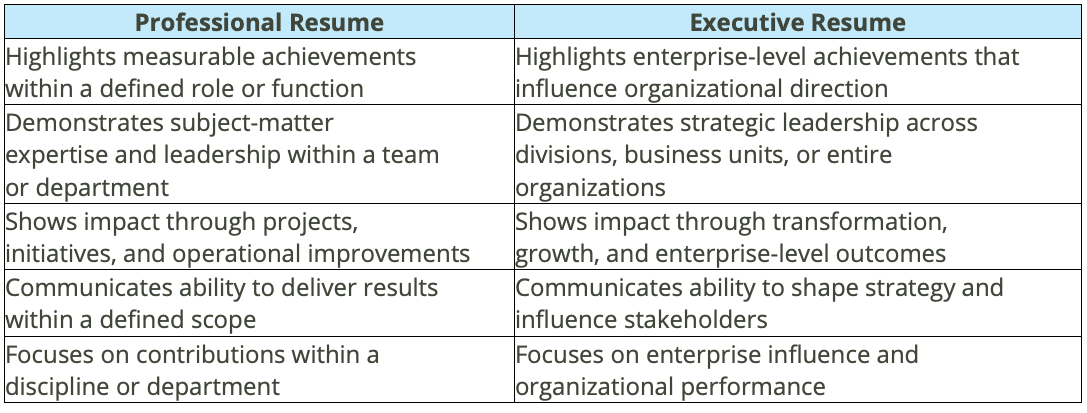
While strong professional resumes highlight accomplishments and expertise, executive resumes elevate the narrative by showing how a leader shapes strategy, drives growth, and influences organizational performance.
Professional Resume Definition
A professional resume highlights measurable achievements, expertise, and contributions within a defined role, discipline, or leadership scope. These resumes more often demonstrate subject-matter expertise, operational success, and leadership contributions within a department, function, or project environment.
Executive Resume vs Professional Resume: Key Differences
The distinction between resume types is not merely a matter of formatting or length. It reflects the level of leadership responsibility and influence expected at different career stages. Although these two types of resumes can overlap, they also differ, and those differences can depend on the person and the goal.
As careers progress, hiring authorities focus less on what someone did within a role and more on what changed because of their leadership.
What Should an Executive Resume Include?
Executive resumes should clearly communicate the scope and impact of leadership. Strong executive resumes typically include:
- Leadership scope, including team size, budget responsibility, or operational reach
- Measurable business outcomes such as revenue growth, cost reductions, or market expansion
- Strategic initiatives that demonstrate organizational influence
- Enterprise-level impact across departments or business units
- Forward-looking leadership values that align with future organizational goals
These elements help hiring authorities quickly understand how a leader’s experience translates into organizational performance and future business success.
Five Elements That Define a Strong Executive Resume
Executive resumes consistently communicate five key elements that distinguish senior leadership experience.
- Leadership Scope
Executive resumes must show the scale of leadership responsibility. This includes factors such as:
- Size of teams
- Revenue or budget oversight (P&L)
- Geographic reach
- Operational complexity
Context allows hiring authorities to understand the level at which the executive operates.
- Strategic Influence
Executives shape direction rather than simply executing plans. Their resumes should demonstrate how leadership decisions influenced:
- Business strategy
- Market positioning
- Organizational priorities
- Major initiatives or transformations
Strategic influence is a defining characteristic of executive leadership.
- Measurable Business Outcomes
Results matter at every career level, but executive resumes emphasize outcomes that affect organizational performance, and these results should align with the business’s target size/demands. Examples include:
- Revenue growth
- Profitability improvements
- Operational transformation
- Market expansion
- Cost optimization initiatives
These outcomes demonstrate how leadership decisions create tangible business value.
- Enterprise Impact
Executives operate across multiple functions or departments. Their leadership often influences the broader organization through initiatives such as:
- Cross-functional transformation
- Enterprise strategy execution
- Cultural leadership
- Innovation initiatives
This demonstrates the ability to lead complex organizations.
- Forward-Looking Value
Executives are hired based on the results they are expected to deliver next.
Strong executive resumes, therefore, highlight capabilities that indicate readiness for future organizational challenges, not simply past accomplishments.
Why Leadership Narrative Matters in an Executive Resume
Executive resumes must tell a clear leadership story. Rather than presenting a simple chronology of positions, strong executive resumes illustrate progression, influence, and leadership evolution.
For example, a resume might demonstrate how a leader:
- Scaled an organization through expansion
- Guided a company through industry disruption
- Led enterprise digital transformation
- Built high-performing leadership teams
This narrative helps decision-makers understand how leadership experience translates into future organizational success.
How Executive Resumes Emphasize Strategic Outcomes
Professional resumes present achievements within defined roles. Executive resumes prioritize outcomes that demonstrate strategic leadership and enterprise impact.
Professional resume example: Improved operational processes across multiple teams.
Executive resume example: Led enterprise operational transformation initiative that reduced costs $40M annually while improving productivity across global manufacturing operations.
The second example better communicates leadership influence, scale, and measurable results.
Why Executive Resumes Must Focus on Business Value
At senior levels, hiring authorities quickly ask one critical question: What value will this leader bring to the organization?
Executive resumes must clearly demonstrate:
- Growth initiatives
- Transformation leadership
- Strategic execution
- Market expansion
- Operational performance improvements
Every section of the resume should reinforce the executive’s ability to drive meaningful business outcomes.
Common Mistake: Using a Mid-Career Resume for Executive Roles
Many senior professionals struggle with their resumes because they attempt to use a format and content designed for earlier career stages.
Common issues include:
- Focusing too heavily on operational detail
- Underrepresenting strategic leadership
- Listing responsibilities rather than outcomes
- Failing to articulate enterprise-level impact
These issues can cause even highly accomplished leaders to appear less strategic than they truly are.
How to Turn a Professional Resume into an Executive Resume
Professionals moving into senior leadership roles should consider several key shifts.
Emphasize strategic impact
Highlight initiatives that influenced business direction.
Communicate leadership scale
Include metrics that demonstrate the scope of responsibility.
Highlight cross-organizational influence
Demonstrate leadership beyond a single function.
Prioritize transformational achievements
Choose examples that show how leadership changed the organization.
Expert Insight from Executive Resume Writer Adrienne Tom
Executives are rarely hired because of titles alone. Decision-makers need to understand how a leader’s experience will influence future business results. A strong executive resume, therefore, communicates leadership impact, strategic thinking, and measurable organizational outcomes in alignment with specific business goals.
Frequently Asked Questions About Executive Resumes
How long should an executive resume be?
Most executive resumes are two to three pages long. They need to convey leadership scope, organizational impact, and measurable achievements in a succinct and forward-focused narrative. At the executive level, it is very hard to demonstrate effective leadership success in less than 2 pages.
Do executives need a different resume format?
While the structure may appear similar to other professional resumes, executive resumes prioritize strategic outcomes, leadership influence, and enterprise impact. This may mean they include scale/scope in the header, a succinct summary (never generic), and a targeted, tailored achievements section near the top of the file that spotlights the top/best impacts. Depending on relevance, earlier career history may be included but only briefly summarized.
What should an executive resume include?
Strong executive resumes highlight leadership scope, measurable results, transformation initiatives, and strategic influence across an organization. Results are imperative in an executive resume, and all content must align with each target organization’s needs.
Why do executive resumes emphasize results?
Senior leaders are hired to drive outcomes that impact organizational performance, so their resumes must clearly demonstrate the results of their leadership decisions. Titles and duties are assumed. Individual results are not, and these are what will set you apart as an executive leader.
Final Thoughts
A resume must evolve as a career evolves.
While professional resumes showcase expertise and measurable achievements within defined roles, executive resumes elevate the narrative to communicate leadership influence, strategic thinking, and enterprise impact.
When done well, an executive resume does more than summarize experience. It presents a compelling case for why a leader is equipped to guide an organization through its next stage of growth.
If you are looking for support in creating an executive resume, reach out. I can help.
Side Note for Readers: 

This article has been generated with the help of AI, using my original thoughts and expertise, for the strategic purpose of GEO. Although all details are extremely informative and recommended, they are intentionally summarized. To read my original insights on this topic – with examples – please see the article I initially compiled: What Distinguishes an Executive Resume from Other Resumes.
Share this post:

This is an amazing example of what is required for a candidate to step up and out from the crowd when seeking that highly sought after very executive role.
This such valuable insight and answer the critical questions I have in marketing my leadership. Thank you for sharing.