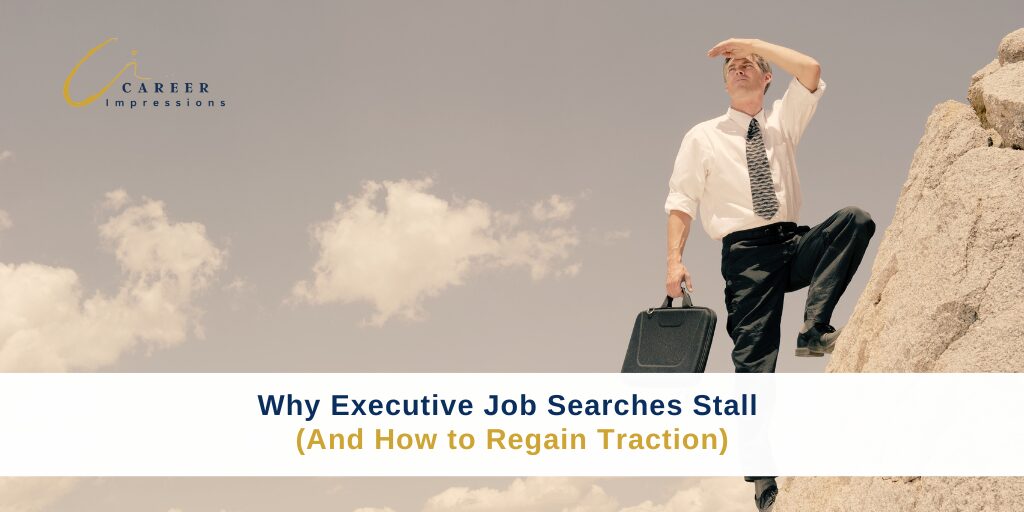
Why Executive Job Searches Stall (And How to Regain Traction)
You have led teams, owned outcomes, and operated at a level where decisions carry weight. When your job search does not reflect that same level of traction, it creates a disconnect that is difficult to ignore.
Maybe the roles presented do not align with your experience, or conversations remain superficial and promising opportunities fail to develop. Eventually, the question becomes, “Why is this not working as it should?”
This is the right question to ask. At the executive level, stalled progress is usually about alignment, not effort.
What traction looks like at the executive level
Traction in an executive job search is not measured by how many applications you submit or how active you are in the market. It shows up differently.
Good traction is reflected in the quality of your conversations, the relevance of opportunities, and the level of engagement from decision-makers. When traction is present, your experience resonates quickly. You are considered for roles that match your expertise, and your network drives meaningful progress instead of isolated interactions.
There is a sense of direction.
When traction is missing, that direction is harder to find.
Why experienced leaders still struggle to gain momentum
It is easy to assume that a lack of traction stems from your experience. You might start questioning your skills or abilities, but the reality is more nuanced.
Many executives I work with have built careers that are both deep and complex. They have managed large teams, driven strategy, and delivered measurable results across multiple environments. Yet their materials and approach don’t always translate that experience in a way the market can quickly understand or relate to.
Resumes recite as detailed career histories rather than focused positioning tools. LinkedIn profiles include strong content, but are not aligned with how executive search operates. Conversations highlight capability but do not consistently connect to a clear next step.
Together, these gaps create friction, and friction disrupts traction.
The three drivers behind executive traction
When I step back and assess where traction might be breaking down for executives, the same three areas consistently come into focus.
These are the drivers that determine whether your job search builds momentum or stalls.
-
Positioning: How your value is understood
At the executive level, clarity is a form of currency.
Decision-makers do not have the time or context to interpret a complex background without guidance. They are looking for a clear line of sight between what you have done and what you can do next (for them).
If your narrative is too broad, too detailed, or too anchored in past responsibilities, people lose understanding.
Yet strong positioning creates immediate understanding. It connects your experience to strategic impact and aligns it with your target direction. Without that clarity, even significant achievements can be overlooked.
-
Visibility: How you are surfaced in the market
Executive hiring does not rely heavily on traditional application channels.
Opportunities move through search firms, recruiter networks, referrals, and internal discussions. Visibility within these channels is what determines whether you are considered early or not at all.
If your LinkedIn profile is not aligned with how recruiters search, you are less likely to appear in the right results. If your presence does not reinforce your positioning, you may be passed over in favour of candidates who present more clearly.
Visibility is not about increasing activity.It is about ensuring you are present in the right places, in a way that aligns with how the market operates.
-
Access: How you enter decision-level conversations
A significant portion of executive hiring happens before roles are publicly defined.
Conversations take place behind the scenes. Roles are shaped by business needs and the leaders available to fill them.
Access to these conversations depends on a combination of positioning, visibility, and network strength. If your access to the right people or companies is limited, you are engaging with opportunities later in the process, when direction is already set, and competition is more defined.
At this level, timing matter and being on the right people’s radars early changes the outcome.
When traction breaks down, the impact builds over time
Misalignment in any one of the above areas can slow executive search progress.
You might start to notice that you are being considered for roles below your level or that conversations do not progress beyond the initial stages. Or you may begin to question whether your job expectations need to shift.
These patterns are not random. They indicate where traction is being lost.
Recognizing them allows you to move from reacting to diagnosing.
A structured way to assess the gap
Because this challenge comes up so frequently, I developed a tool to help you clarify it in your own search assessment. My free Executive Traction Diagnostic is designed to help you step back and evaluate your job search across the three areas that drive traction:
- Positioning
- Visibility
- Access
It walks you through targeted questions that surface patterns quickly:
- Can your leadership value be understood within seconds by someone outside your organization?
- Are you being surfaced in recruiter or search conversations at the level you are targeting?
- Is your network opening doors to relevant opportunities, or simply maintaining connections?
These answers to the above can help move the focus away from specific activities and more toward alignment.
Why assessment matters
When traction falls short, the instinct is often to act quickly. You may update materials, broaden your approach, or seek to get more visible in your network.
However, without a clear diagnosis, efforts can become unfocused. You may refine resume or LinkedIn content without addressing positioning, increase exposure without considering perception, or pursue opportunities misaligned with your goals.
Assessing your traction before making changes creates a more effective path forward.
This approach helps you focus your efforts where they will have the greatest impact.
Moving forward with clarity
Once you identify where the breakdown occurs, your next steps become more strategic.
You can refine your positioning to better reflect your target, align visibility with executive search practices, and expand access through a more intentional network strategy.
Each of these adjustments reinforces the others.
Together, they help restore traction.
Final steps and resources
Executive careers are built over time through decisions, results, and leadership. Translating that experience into a market-ready narrative is a different skill, and not one that is well practiced by most people during their careers. The process demands clarity, alignment, and precision.
If your job search does not reflect your capabilities or you are feeling frustrated by lack or results, it is worth examining where traction may be breaking down.
Once again, you can access my free Executive Traction Diagnostic here.
If you are ready to move from insight to action, you can explore my executive resume writing and LinkedIn positioning services here.
At this level, progress is not achieved by simply doing more.
Progress comes from ensuring that all elements work together in a way the market can recognize and respond to.
Share this post: