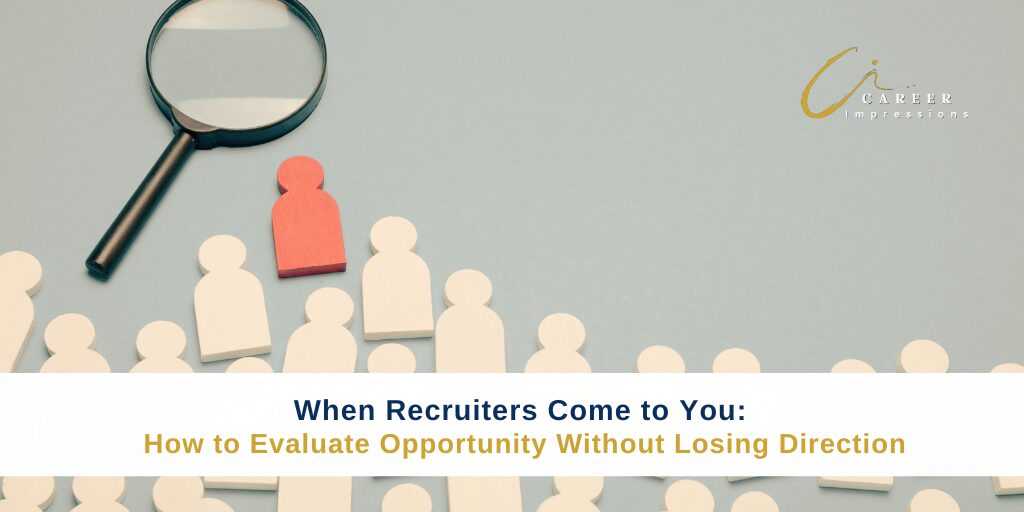
Recruiter Outreach: How to Evaluate Opportunities Without Losing Direction
It can feel good to be pursued by recruiters. When a recruiter contacts you about a job you did not seek out, it can feel validating and maybe even exciting. This outreach shows that your experience and value are getting noticed. But that excitement can sometimes distract you from the important task of deciding if the opportunity is right for you.
I have been watching this play out in real time with someone close to me.
He works in a specialized field, and lately, recruiters have been contacting him often on LinkedIn. The jobs match his skills, the conversations are interesting, and everything seems positive at first glance. I helped him with his profile, so it is working as planned by attracting attention and opening new doors.
But here’s the thing. He is not looking to change jobs.
He is happy, comfortable, and established in his current role, which changes how he approaches these conversations. Rather than being swept up in the initial excitement, he is taking a measured approach, asking more thoughtful questions, and treating each interaction as a two-way evaluation rather than a one-sided opportunity.
This shift is more important than many people think.
After the excitement of being contacted fades, you start to see things more clearly. That is when you notice if something does not match what you want, feels off, or brings up questions that need more thought. Call it a moment of pause and analysis.
This moment of pause is when it is important to do your homework and conduct due diligence. When someone reaches out to you, it is easy to think the opportunity must be a good fit just because they found you. But that is not always true. Some roles may not match your goals, even if they seem legitimate. The best candidates take their time and carefully evaluate each opportunity.
Here are three practical steps you can take to help.
-
Look beyond the surface when researching the company
A polished website and a well-crafted recruiter message can make a strong first impression, but they do not tell the whole story. Research things like leadership changes, recent company news, financial health, and what employees are saying online. Look for patterns over time, not just single events.
These details often reveal what you will actually be stepping into, which is far more important than what is being marketed at the outset.
-
Ask smarter, more strategic questions
Surface-level questions will only get you surface-level answers. If you want to assess fit at a senior level, your questions need to reflect that level of thinking. Ask about current challenges, decision-making frameworks, leadership dynamics, and what success truly looks like beyond the first 90 days. Many professionals miss an important opportunity here because having these conversations helps both you and the company understand your value and priorities, even if you are not looking to move. That is why it is worth taking the call, even when you are happy in your current job.
You may discover that you are being sought after for a very specific reason, one that you have not fully leveraged in your current role. That insight alone can influence how you position yourself internally and may even strengthen your case during your next review.
You may also start to notice patterns.
If several recruiters ask how you use AI to reach new markets, it is not by chance. This shows how expectations are changing, and it might be something you want to focus on, whether you stay or move on.
-
Know your non-negotiables
These serve as your anchor.
When you know what matters most to you—like leadership, culture, pay, flexibility, or growth—it is much easier to say no to jobs that look good but do not really fit your needs. Without this clarity, it is easy to talk yourself into jobs that seem exciting now but may cause problems later.
And although logic and strategy are important, there is another factor you should not ignore. Trust your instincts. Your intuition is a valuable guide, even if you do not always recognize it. If something feels wrong, even if you cannot explain it, pay attention. Small warning signs often show up early and ignoring them usually does not end well.
It feels good to be wanted. But being wanted is not the same as being the right fit.
The best candidates know they should not just react to offers but evaluate them carefully. They ask good questions, look for deeper signs, and make choices based on their goals, not just what is available.
When I first shared these thoughts on LinkedIn, the response was much bigger than I expected. The post started many good conversations about how professionals handle job offers and recruiter messages.
You can read the original post here. It’s gone viral!
Share this post: