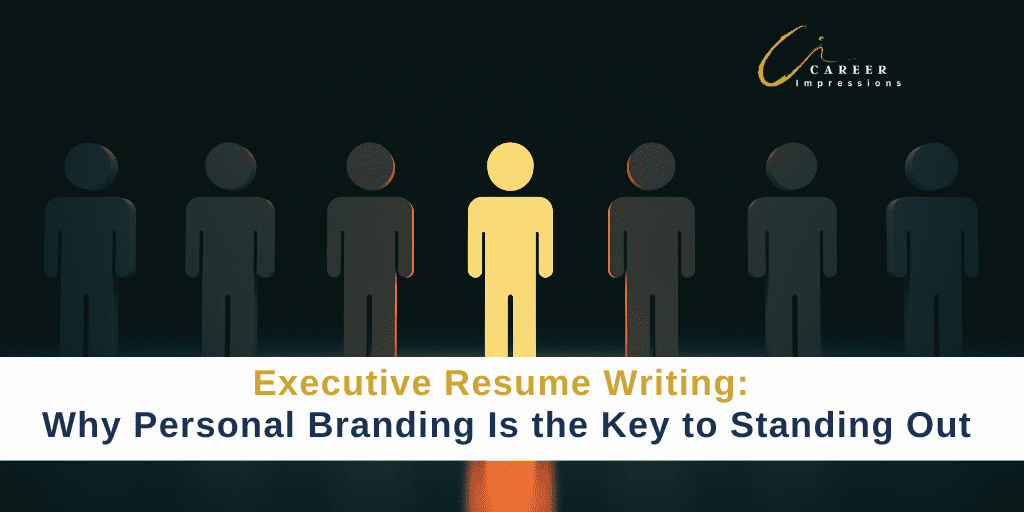
Executive Resume Writing: Why Personal Branding Is the Key to Standing Out
In an increasingly competitive job market, standing out as an executive candidate means that your resume needs to do more than outline where you’ve worked. It should tell a compelling story about who you are as a leader and why you’re the right fit for the next opportunity. Think of it less as a record of employment and more as a strategic pitch: a narrative that highlights your distinct value and the measurable impact you create for organizations. This is otherwise known as your personal brand, and incorporating personal branding into your resume is essential.
According to a CareerBuilder survey, 70% of employers use social media to screen candidates, and LinkedIn’s data shows that candidates with strong personal brands and complete profiles receive far more inbound opportunities. Your resume is one of the first—and most critical—places to define and display this brand.
Your Resume as a Strategic Marketing Tool
At the executive level, your resume must function as a strategic marketing document. Your personal brand is your unique value proposition. It answers key questions:
- What problems do you solve better than anyone else?
- What impact can you make on this organization?
- Why should they choose you over someone with similar experience?
Creating a powerful executive resume begins with deeply understanding what you bring to the table—and then communicating it clearly, consistently, and credibly.
Lead With a Brand Statement
Start strong. Your personal brand statement, placed at the top of your resume, should serve as a headline that captures attention and instantly conveys alignment with the organization’s needs. Think of this as your “hero” statement: what is the defining theme of your leadership journey?
Effective brand statements:
- Solve a specific business problem
- Reflect company culture fit
- Reinforce your most significant professional value
- Are specific, not vague
Examples:
- “Transforms complex operations into scalable systems that fuel 2X revenue growth.”
- “Global executive who builds resilient, high-performing teams that deliver innovation in fast-changing markets.”
Build a Summary That Tells Your Story
The top third of your resume is prime real estate. Use this space to share a career summary that highlights your brand, summarizes your top career achievements, and sets the tone for the rest of your document.
Focus on outcomes, not job duties. Employers already know what a CFO or VP of Operations does. What they want to know is how you performed in that role, and how that performance benefited your employer.
For example…instead of: “Oversaw supply chain logistics.”
Try: “Reduced shipping delays 47% through redesigned supplier scorecard and lean process optimization.”
Back It Up With Proof
A strong personal brand isn’t built on adjectives. It’s built on results.
If you claim to be a transformational leader, show how you transformed a business unit. If you describe yourself as results-driven, back that up with revenue growth, cost savings, or team performance metrics.
Research from Harvard Business Review emphasizes the power of storytelling in leadership and influence. The best executive resumes use storytelling to communicate how you’ve overcome challenges, delivered results, and led change.
Be Specific and Authentic
Specificity shows clarity. Generalizations dilute your message.
If you scaled a business, say by how much and over what timeframe. If you reduced turnover, include the percentage and what drove the change. If you built a culture of innovation, include examples that prove it.
Equally important is authenticity. Your brand must be a true reflection of who you are. You can tailor your resume to the company and the role, but your core value should remain consistent across all materials: your resume, LinkedIn profile, and interviews.
Showcase Your Combined Strengths
Executives are hired not only for what they know, but for how they lead. Your resume should reflect both hard and soft skills:
- Strategic planning, operational transformation, revenue acceleration
- Team leadership, change management, communication
Use your personal brand to connect the dots between these strengths. This holistic picture is what makes you a compelling candidate.
Align With Company Needs
Your brand is only powerful if it’s relevant. Align your resume with the outcomes and values that matter most to your target employer. This is where research plays a role. Understanding the company’s strategic goals and culture can help you tailor your message.
Ask yourself: What challenges is this company facing that I’m uniquely positioned to solve?
Keep It Consistent Across All Channels
Consistency builds trust. A recruiter should get the same impression of your leadership brand whether they’re reading your resume, reviewing your LinkedIn profile, or interviewing you. Visual design, tone of voice, and key messaging should align across platforms.
According to Forbes, executive branding is about managing your reputation and digital footprint as intentionally as you manage your P&L. Your resume is a cornerstone of that reputation.
An executive resume must go further than listing roles and responsibilities to showcase the ROI you deliver. With employers more selective than ever, your personal brand provides the edge that shifts you from applicant to standout leader. A strong personal brand is your differentiator.
Take the time to dig deep. Get clear on your strengths. Align them to employer needs. And don’t just say it—prove it.
That’s how you turn a good resume into a powerful personal brand.
Need help uncovering your unique value in alignment with your target leadership role and effectively positioning it on paper? I can help!
Share this post: