Executive Resume Before and After: From Uncertain to In-Demand
A Chief Human Resources Officer reached out to me and said something I hear more often than you might expect: “I know I’ve done meaningful work. I just don’t see it on the page.”
He was accomplished. Strategic. Deeply experienced across talent, culture, and organizational design. Yet his resume felt flat. And when you are targeting CHRO roles, flat is expensive.
Let me walk you through what changed and why it mattered in this executive resume before-and-after case study.
The Resume Before: Experience Without Positioning
At a glance, his original resume had three major issues.
1. No Clear Brand
His summary read like dozens of others. It listed years of experience and broad responsibilities, but it did not define who he was in the market or what kind of CHRO he had become.
There was no articulation of:
-
The environments he thrived in
-
The scale he operated at
-
The transformation mandates he had led
-
The business outcomes he consistently influenced
When a board or CEO scans a resume, they are not asking, “Is this person experienced?” They are asking, “Is this the leader who can solve our unique business problems and help us with the next chapter?”
That answer was not obvious in this CHRO’s executive resume.
2. Claims Without Proof
The old resume referenced culture-building, talent development, and strategic partnerships. Important, yes. But where were the metrics? The business impact? The evidence?
HR leaders often undersell their commercial influence. In his case, there were powerful stories around workforce redesign, executive succession planning, and post-acquisition integration. None of them were quantified or positioned as enterprise outcomes.
The result: the resume read like effort, not impact. And guess what? Everyone puts effort into their work, but the level and the end result are what matter most.
3. Basic Presentation
The format was serviceable but generic. No visual hierarchy or executive tone. No cues that this was a board-level HR leader operating in complex environments.
At the CHRO level, your resume is not just a document. It is a signal of how you think, how you prioritize, and how you present information to stakeholders. You don’t necessarily need a fancy format, but you do want to ensure the file looks modern, reads easily, and is formatted in a way that naturally guides the reader’s eye, particularly to key points.
My Process: How We Rebuilt the Narrative
At Career Impressions, I do not “edit” executive resumes. I build leadership narratives from the ground up, working in partnership with each client to unearth and position their related strengths and value.
My process with this CHRO followed the same framework I use with senior leaders across industries:
Step 1: Clarify the Target
Before writing a word, we narrowed his job target. Ever heard the expression: “taking shots in the dark”? Well, without a very precise and narrowed job target in mind, your resume will be just like that — aiming at nothing and landing nowhere.
Was he pursuing a transformational CHRO role in a PE-backed environment?
A culture and engagement mandate in a growth-stage company?
A steady-state enterprise HR leadership role in a mature organization?
Your career tools cannot be a catch-all. They must align with a defined direction.
Before doing anything, we clarified my client’s ideal scope, environment, and mandate. That decision shaped everything that followed.
Step 2: Extract the Real Value Proposition
Through a structured assignment and a detailed one-to-one interview, I pulled out patterns:
-
He consistently entered organizations during periods of change.
-
He redesigned HR operating models to align with the growth strategy.
-
He partnered tightly with CEOs on succession and executive capability.
-
He linked culture initiatives to measurable performance improvements.
That became his brand.
He was not simply an “experienced HR leader” (bland, basic, boring). Instead, he was a transformation-focused CHRO who aligns people strategy with enterprise growth (clear, concise, powerful).
Step 3: Translate HR Impact into Business Language
We reframed his work in terms businesses care about:
-
Revenue growth support
-
Cost optimization through workforce planning
-
Retention and engagement metrics
-
Leadership bench strength
-
Post-merger integration outcomes
Instead of saying he “led culture initiatives,” we showed how those initiatives reduced regrettable turnover, accelerated leadership readiness, and stabilized performance during change.
Proof replaced generalities.
Step 4: Apply Executive-Level Format and Visual Strategy
Presentation matters. Again, by presentation, I don’t mean ‘fancy’. I mean clear, easy to read, inviting, modern. The resume needs to be visually interesting and chock-full of great content from start to finish.
We created:
-
A strong, targeted headline aligned with his CHRO mandate
-
A concise executive summary that articulated scope, scale, and leadership philosophy
-
Select leadership highlights that front-loaded major wins
-
Clean formatting with visual hierarchy so key achievements were easy to scan
The document felt intentional, strategic, and executive-ready.
Confidence followed.
The Resume After: Measurable Results
Once the new resume was launched into the market, his feedback came to me a few months later.
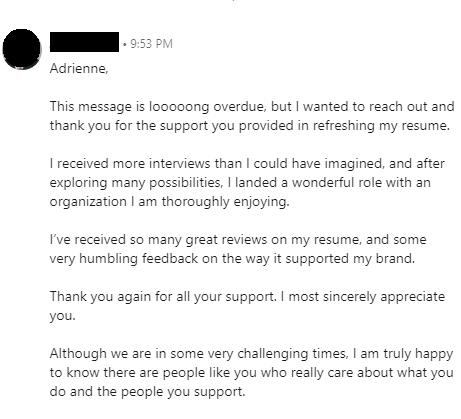
He told me he had received “more interviews than I could have imagined” and had accepted “a wonderful role with an organization I am thoroughly enjoying.” Additionally, he mentioned that he had gotten great feedback on how the resume “supported my brand”. Bingo!
Same career.
Same experience.
Completely different positioning.
That is the power of alignment.
Looking for a visual on what a great executive resume looks like? Check out the resume samples on my website.
Each of my resume samples demonstrate the implementation of the strategy outlined above in this article, and it is what you need to follow, using your own words and work history, to achieve individual resume success.
What This Executive Resume Case Really Shows
Executives rarely lack experience, but more often than not lack narrative precision.
When your resume:
-
Clearly defines who you are
-
Aligns tightly with your target
-
Demonstrates business impact
-
Communicates with executive polish
You stop hoping someone connects the dots and you connect them for them.
If you are a senior leader or executive and your resume still reads like a job description, it may be time to revisit how you are telling your story. Because at the executive level, the resume is not about listing responsibilities. The file needs to earn you a seat at the table before you ever walk into the room.
If you would like to see how your current resume stacks up, I invite you to review my process and specialties at Career Impressions and consider whether your leadership narrative is working as hard as you are.
Share this post: